

Jarred Shaw’s case shows cannabis justice does not stop at U.S. borders


As cannabis policy continues to shift across the United States, the case of Jarred Shaw has become a stark reminder that legalization, medical access, and changing attitudes at home do not protect patients or consumers abroad.
Shaw, a 35-year-old American professional basketball player and former collegiate standou, remains incarcerated in Indonesia after cannabis gummies he said he used to help manage Crohn’s disease led to a 26-month prison sentence.
Reuters reported in April that Shaw admitted to importing 132 cannabis gummies, but said they were intended to relieve symptoms related to Crohn’s disease, a chronic inflammatory condition that affects the digestive tract.
While Indonesian drug trafficking charges can carry the death penalty, Shaw was ultimately convicted on a lesser possession charge and sentenced to 26 months in prison in Tangerang, where he had been playing for the Hawks in the Indonesian Basketball League.
For cannabis advocates, Shaw’s case is not simply about one athlete. It is about the gap between state-regulated cannabis access in the U.S. and the severe penalties still attached to cannabis in other parts of the world.
Willy Vlasic, CEO of Vlasic Labs, said Shaw’s case has become the primary focus of the Vlasic Classic tournament series and The Forgotten Prisoner Foundation, the advocacy organization led by Donte West.
“We just had our fourth annual Missouri Classic,” Vlasic said. “We’ve got our third annual in Michigan coming up, and then our second annual in Vegas. And now after the Missouri one, we’ve raised over $165,000 over the past few years, over seven or eight classics. And I’m hoping to get that to $200,000 by the end of the year and bring Jarred Shaw home.”
The Missouri Vlasic Classic raised $25,000 for cannabis justice organizations this year, including $20,000 for The Forgotten Prisoner Foundation and $5,000 for Freedom Grow. Funds through The Forgotten Prisoner Foundation are intended to support Shaw and his family while advocates continue pushing for humanitarian relief and early release.
Vlasic said Shaw’s medical condition is central to the urgency.
“He has Crohn’s disease and serious health issues because of it,” Vlasic said. “He ordered some gummies online from Thailand to his house, and it was only like $400 of gummies.”
According to Vlasic, West traveled to Indonesia, became Shaw’s international advocate, and helped raise money and awareness around the case. Reuters reported that Indonesian officials say Shaw has access to medical care, but Shaw disputes whether the care is sufficient for his condition. Shaw told Reuters his health has deteriorated in custody, citing weight loss, stomach pain, nausea, vomiting, infection, and the difficulty of managing Crohn’s disease in prison.
Vlasic described the sentence reduction as meaningful, but incomplete.
“Thanks to Donte and all these sponsors and donors, we were able to get his sentence reduced to 26 months, which is obviously a huge win,” Vlasic said. “And at the time when he got death row, there was a huge media frenzy. All these big media outlets were telling his story, and then he got off death row and people kind of forgot about him. And that’s why Donte calls his charity The Forgotten Prisoner.”

Vlasic said Shaw’s health remains the immediate concern.
“Although it’s a huge win, obviously, to get him from death row to two years and change, he has Crohn’s disease. He now has E. coli and internal bleeding from being in this prison. He’s lost 50 pounds. He can’t play pro ball anymore or support his family,” Vlasic said.
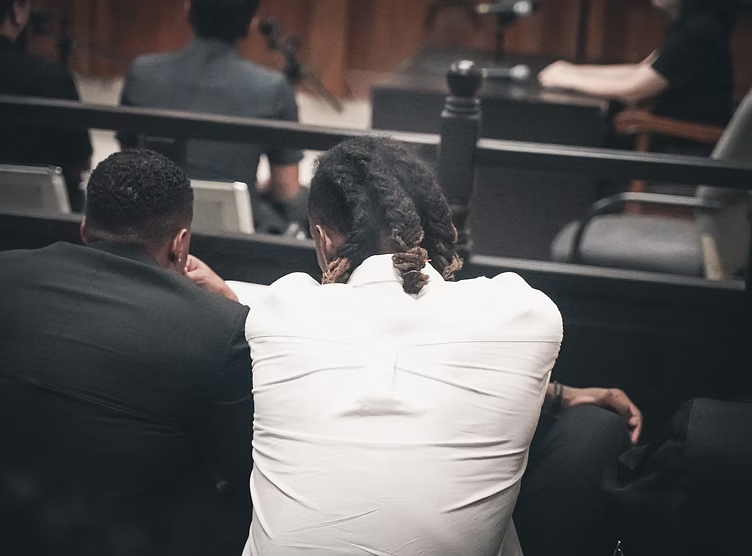
For Vlasic, the case also highlights an uncomfortable contrast for the legal cannabis industry. Cannabis businesses in the U.S. are building brands, hosting events, raising capital, and benefiting from markets where adult-use and medical cannabis are normalized. At the same time, people remain imprisoned for cannabis-related conduct, both domestically and internationally.
“As much as the money helps, getting him home, getting him a doctor, getting him back on his feet, helping his family, that’s crucial,” Vlasic said. “But the awareness and the media and the fact we have this golf tournament and his brothers came, and the hope you give these people is almost just as important as the money, because until you’re able to get them home, that’s all they have.”
Shaw’s case has also become a cautionary example for athletes, patients, and cannabis consumers who travel internationally. State legality in the U.S. does not follow a person across borders. In some countries, cannabis, hemp products, CBD, THC, and edibles are treated as serious narcotics offenses regardless of whether the products were purchased legally elsewhere or used for medical reasons.
That point is especially important as more athletes and professionals move between countries for work. In the U.S., cannabis products may be sold through licensed dispensaries, used by registered patients, or available as hemp-derived products under certain limits. In Indonesia, cannabis remains illegal, and U.S. officials warn travelers that prohibited items include marijuana, cannabis, hashish, edibles, and products containing CBD or THC, even if prescribed elsewhere.
Vlasic said the difference between U.S. cannabis norms and international enforcement can be hard for people to understand until a case like Shaw’s makes it visible.
“They’re like, ‘Oh, well, it was illegal in America, and I smoked weed when it was illegal here,’” Vlasic said. “But it’s not the same thing as when you go to the Far East and some of these more strict countries.”
He added, “It’s different in every country, so you really need to be careful when you’re traveling.”
For advocates, the goal now is to keep Shaw’s case from fading. The work includes fundraising, media attention, family support, and diplomatic pressure. It also includes reminding the cannabis industry that legalization does not erase the harms of prohibition for people still living with its consequences.
“Jarred right now is our primary and only focus,” Vlasic said. “We’re confident we’re going to be able to get him home early.”
That outcome is far from guaranteed. But for Shaw’s family, his advocates, and the cannabis businesses rallying behind him, the mission is clear: bring attention back to a case that could otherwise be forgotten, and bring Shaw home before his health suffers permanent damage.
