

Shangri-La bets on Connecticut with Borealis expansion

Shangri-La Enterprises is making one of its largest bets yet in Connecticut.
After launching in Missouri and expanding retail operations into Ohio, Connecticut, Illinois, and Delaware, the company is now turning its attention to a deeper operational play in Connecticut through Borealis by Shangri-La, the company’s cultivation and manufacturing brand.
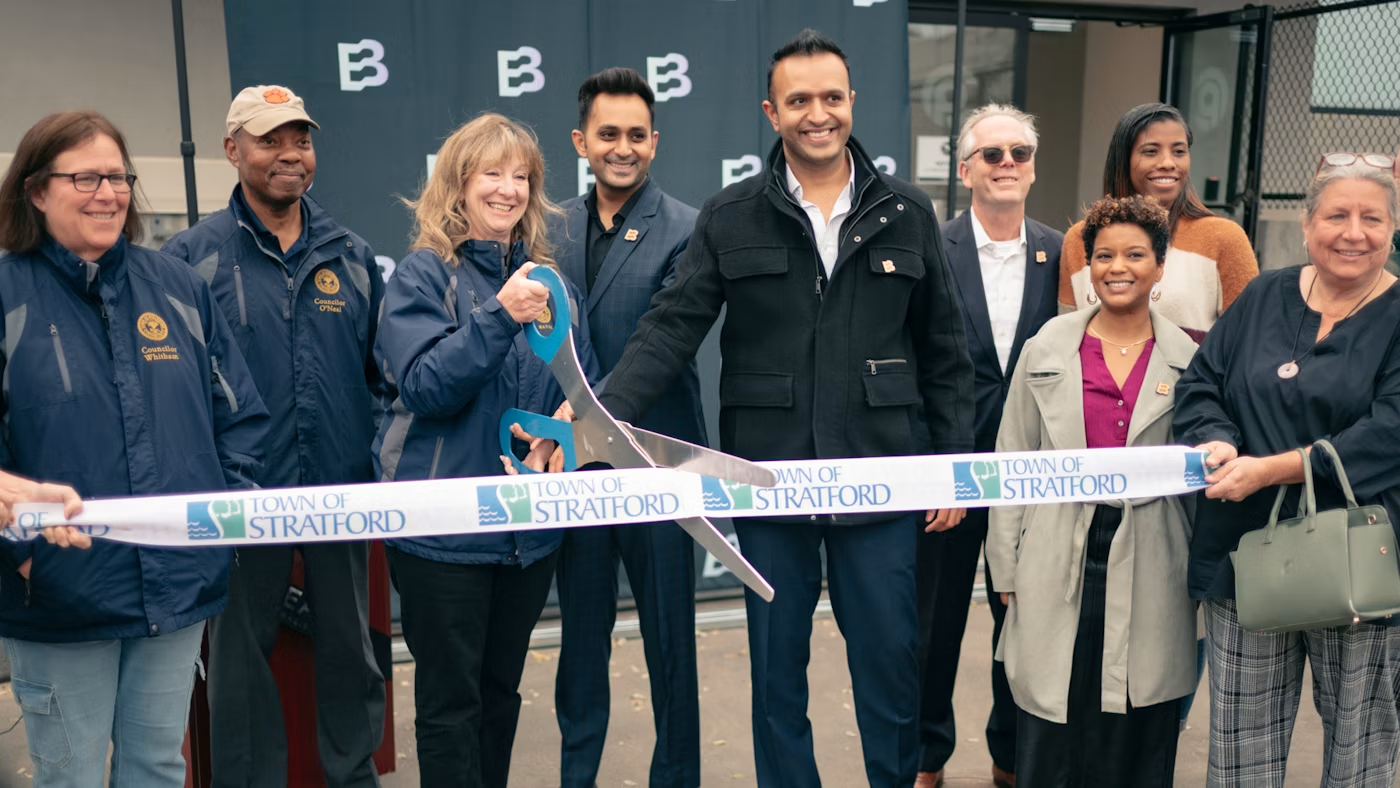
In November, Borealis announced the opening of a new state-of-the-art cultivation and production facility in Stratford, Connecticut. The 40,000-square-foot facility represents a $34 million investment and is expected to produce 1,000 pounds of finished, trimmed flower monthly.
For Dr. Kepal Patel, co-founder and president of Shangri-La Enterprises, the investment is not built around where Connecticut’s cannabis market is today. It is built around where the company believes the market can go.

“The vision is not where the market is today,” Patel said. “The vision is where the market’s going to be two years from now, five years from now, and 10 years from now.”
That long-term view is central to Shangri-La’s Connecticut strategy. The company already operates retail locations in the state, giving it a direct connection to consumers and a built-in channel for product feedback. But Patel said the company’s manufacturing and cultivation ambitions are not limited to filling its own shelves.
The goal is to build Borealis into a consumer-driven product line that can compete across the broader Connecticut market.
“If we are creating a manufacturing and cultivation product, your goal should be to make sure you maximize that you’re selling as much as possible,” Patel said. “If it is a true product and if it’s a product that consumers want, you’re going to sell through it, whether it’s your retailer or outside retailer.”
That distinction matters in a state like Connecticut, where Patel said consumers have faced high prices and limited product variety. In the company’s view, the opportunity is not simply to add another cultivation facility to the market. It is to help expand the market’s product depth, improve consumer access, and create a stronger reason for Connecticut consumers to shop in-state.
Patel said Shangri-La identified two core issues in Connecticut: pricing and variety.
“One is, unfortunately, consumers, because the pricing is significantly so high, it used to be very high in Connecticut where consumers are crossing state borders to get the product they need from next states,” Patel said. “Second biggest problem was also the variety of the products. The consumer just did not have, and still to this day they don’t have, the SKUs that they could very well go into a Connecticut store and get everything that they’re looking for, whether it’s concentrate or gummies or vape.”
That analysis shaped the company’s decision to build a facility designed to support a broad portfolio of products. Patel described the Stratford operation as a fully indoor, state-of-the-art facility built around consistency, quality, automation, and plant health.

He said the facility includes advanced systems across cultivation and production, from grinding and packaging to software and plant monitoring. The company’s intent, he said, is to create a platform capable of delivering variety at a price point that can better compete with neighboring markets.
“We also wanted to give the consumers of Connecticut an experience that no other brand is able to provide until now,” Patel said. “We wanted to replicate how the Missouri market is. And when I say Missouri market, I mean in terms of pricing as well as in terms of all the product, quality products they can get at a rate that makes sense to them.”
Missouri serves as a useful comparison point for Shangri-La. The company launched retail operations in Missouri during the medical market and later expanded into cultivation and manufacturing through Borealis. That experience helped inform how Shangri-La views vertical operations in other states.
But Patel said the company does not view vertical integration as a shortcut or a guarantee. Retail stores can provide a buffer, but they cannot be the whole business plan.
“We don’t want to take being vertical for granted,” Patel said. “If we are creating a separate business, a manufacturing business, if we’re creating vapes, if we’re creating gummies, we want to make sure the consumer really asks for those gummies.”
In Connecticut, that means Borealis has to stand on its own.
The brand was developed to separate itself from more traditional cannabis branding. Like Shangri-La, Borealis avoids the common green, leaf-driven visual identity used by many cannabis companies. Patel said the Borealis name was built around the idea of the Northern Lights and the sense of wonder tied to that natural phenomenon.
“We wanted to stay away from the common green theme, the common names associated with leaf and all of those things,” Patel said.
The brand is intended to connect with consumers as a lifestyle product, not only as a dispensary SKU.

“We wanted our consumers to get that out of this world experience,” Patel said. “Have that feeling that they’re being part of this lifestyle that Borealis represents.”
In Connecticut, that brand identity will be tested in a competitive environment. Shangri-La is entering the market against existing Connecticut operators and national cannabis brands with established recognition. Patel said the company expects Borealis to compete through product quality, pricing, and consumer experience.
“That’s the hardest part,” Patel said of building brand awareness in Connecticut. “We have all these national competitors we’re competing against. We have local Connecticut businesses that are in the cannabis industry that we’re competing against. But I think at the end of the day, we are going to be truly set apart with the quality of the product we provide, our pricing associated with it, and the experience that consumer gets.”

Patel said consumers ultimately care about two things: whether the price makes sense and whether the product delivers the desired experience.
“They don’t care about the amount of money you spend on that facility,” Patel said. “All they care about is two things, right? The pricing, does that make sense? And how does the product make them feel?”
That consumer-first lens also affects cultivation planning. Patel said Connecticut, like other newer adult-use markets, still has consumers who look first at THC percentage. At the same time, more mature markets show that many consumers eventually begin paying closer attention to flavor, terpene profile, and overall experience.
Missouri has followed that pattern, Patel said, with THC percentage still important but no longer the only factor driving purchase decisions.
“People are starting to get away from the THC content alone,” Patel said. “That’s what we saw in Missouri, and that’s the effect we’re kind of seeing trickle down to Ohio and Connecticut as well.”
Still, he said, THC remains one of the top purchasing factors in the market, and Shangri-La has to account for that demand while also building products around terpene and flavor profiles.
“If there is a decent percentage of population looking at the THC percentage, that’s where we provide it to them,” Patel said. “So that’s where, again, a bigger facility and having that ability in terms of our Connecticut cultivation has 13 different rooms. Having that ability to make sure that a certain type of strain which can be very aromatic or which can be high in terpene gets to, we have the luxury to be able to put that into a separate room and have a certain strain that we’re strictly growing for a higher THC percentage to cover all that basis.”
That flexibility is part of the reason Patel said the company remains confident in Connecticut. The facility gives Borealis room to produce across multiple consumer demand points, including flower, concentrates, gummies, vapes, and other product categories.
According to the company’s announcement, the Stratford plant will employ 80 workers across cultivation, processing, compliance, packaging, and administrative operations. In the announcement, Nevil Patel, CEO of Shangri-La, said the investment is intended to support the company’s broader national growth.
“We’ve invested $34 million in the most cutting-edge cultivation and manufacturing technology to provide needed product to fuel our national growth,” Nevil Patel said. “We’re thrilled to build and operate these new facilities in Connecticut, where we’ll add 100 new employees to our growing presence in the state.”
At the time of the interview, Kepal Patel said Shangri-La had completed its first Connecticut harvest and was in the process of testing product before bringing it to market.
“We had our first harvest last month,” Patel said. “We are in the process of getting it tested, and then hopefully it’ll be in the market very shortly.”
The investment is substantial, particularly in a state market that remains smaller than Missouri. But Patel said the size of the investment reflects the company’s intent to build for quality, scale, and long-term market development rather than simply enter the state with a smaller production footprint.
“We didn’t want to cut any corners,” Patel said. “We truly wanted to provide that experience in Connecticut for those consumers.”
That approach mirrors Shangri-La’s broader expansion strategy. The company has focused on winning licenses organically through state processes rather than relying primarily on acquisitions. Patel said that approach helped Shangri-La expand from Missouri into Ohio and Connecticut, and it remains part of the company’s growth model.
“Our strategy always has been, and to this day still, to win licenses organically,” Patel said.
Now, Connecticut is becoming a test of what Shangri-La has learned across multiple markets. Missouri gave the company experience launching retail, building a local brand, and developing Borealis. Ohio added another state market. Connecticut now gives the company a chance to combine retail, cultivation, manufacturing, and brand-building in a market where the company believes consumer demand has not yet been fully served.
For Patel, the opportunity is clear: Connecticut consumers need more product variety, better pricing, and a brand that can earn their trust beyond Shangri-La’s own stores.
“We want to make sure we give the perfect experience to the consumers,” Patel said. “They come in and ask for Borealis flower. They come into any dispensary and ask if we’re carrying Borealis flower, if we’re carrying Borealis gummies.”
That is the larger ambition behind the Stratford facility. It is not simply a new grow. It is Shangri-La’s attempt to shape the next stage of Connecticut’s cannabis market by building a product platform that can compete on quality, range, and value.
If the company is right, Connecticut is not a small-market side project. It is a market waiting for more supply, more choice, and a stronger in-state product identity.
“We still stand behind that vision,” Patel said. “We still have not opened up the Connecticut market to its full potential.”
